
Management Structure
Corporate Governance Structure
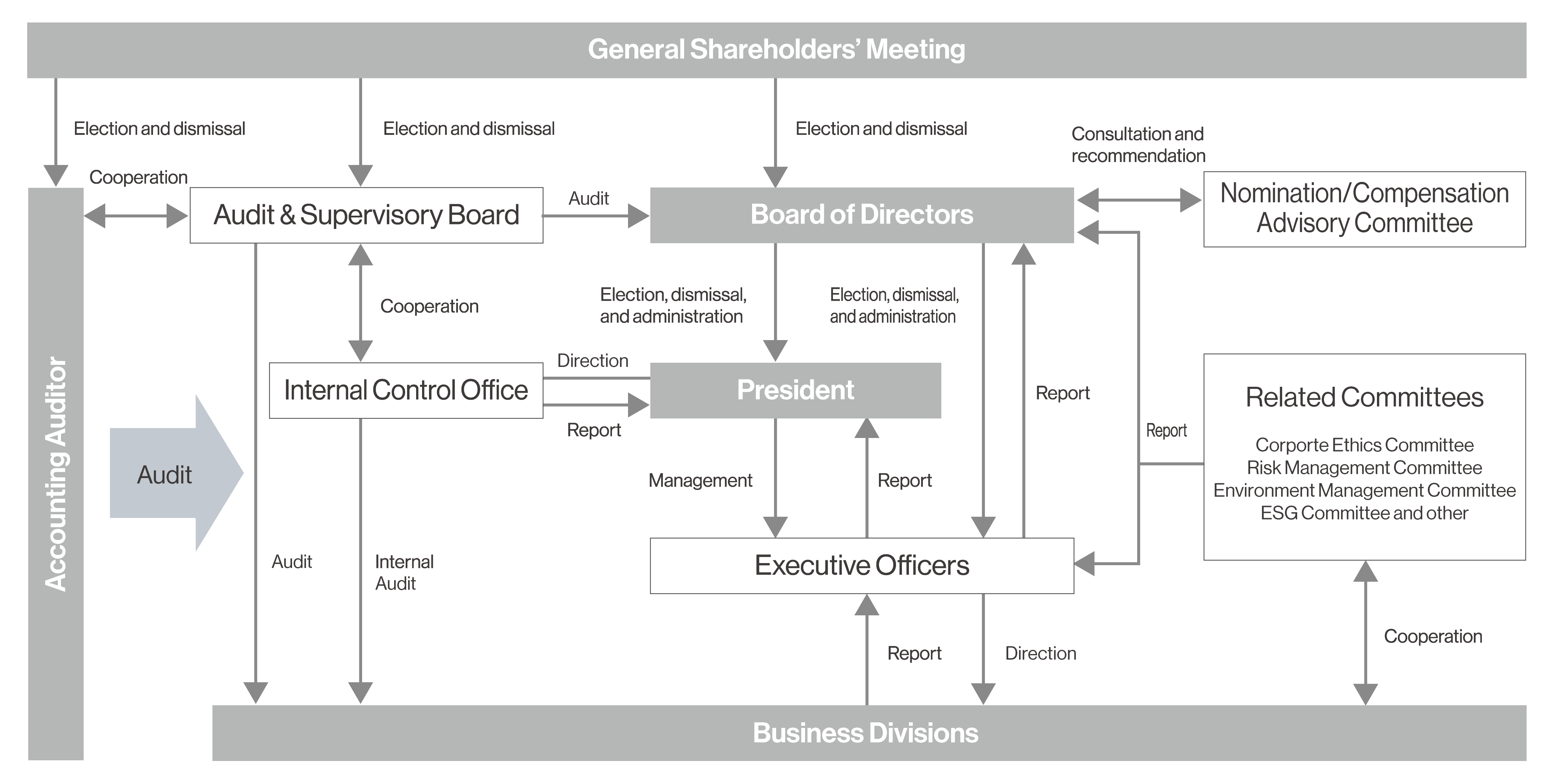
Audit System for Monitoring and Supervising Management
Rinnai recognizes the reinforcement and enhancement of its corporate governance to be important management priorities from the perspectives of strengthening competitiveness and continually improving corporate value of the Group. We aim to conduct highly transparent management by providing swift and precise disclosure of wide-ranging information to all of our diverse stakeholders while endeavoring to enhance the functionality of internal bodies, such as our Board of Directors and Audit & Supervisory Board.
Audit & Supervisory Board members attend Board of Directors’ meetings and other important meetings to monitor director and executive organization execution of duties and development and operation of the internal control system. In addition to these duties, external account auditors audit the Company’s accounts and verify from a third-party perspective the legality of the internal control system as it relates to financial accounts.
Board of Directors
Rinnai’s Board of Directors is comprised of nine members, four of whom are outside directors, and meets once a month in principle. The Board makes decisions regarding major management issues and also oversees business execution by Board members. In addition to resolutions on matters such as M&A deals, the Board of Directors also discusses measures aimed at realizing management that is conscious of capital costs and stock price, evaluates the effectiveness of the Board of Directors, and reports on feedback from dialogues with investors.
Skills Matrix of Directors (Areas particularly expected of the relevant directors)
*The following table does not represent all of the candidates' knowledge and experience.
| Expertise and Experience | |||||||||
|---|---|---|---|---|---|---|---|---|---|
| Corporate management | Global management | Technology (Development / Production / Environment)(E) |
Business Plans / Marketing | Finance / Accounting / Capital Policy | Human Resources Strategy (S) | Governance (G) / Legal matters / Risk management | Sustainability | IT / DX | |
| Kenji Hayashi | ✓ | ✓ | - | - | ✓ | ✓ | ✓ | - | - |
| Hiroyasu Naito | ✓ | ✓ | ✓ | - | ✓ | - | - | ✓ | - |
| Hideyuki Shiraki | - | - | - | ✓ | - | ✓ | ✓ | - | ✓ |
| Kazuto Inoue | - | ✓ | ✓ | - | - | - | - | ✓ | ✓ |
| Hirohisa Ooi | ✓ | - | - | - | ✓ | ✓ | - | ✓ | - |
| Tadashi Ogura | ✓ | - | ✓ | - | - | ✓ | ✓ | - | - |
| Yoko Dochi | - | ✓ | - | - | ✓ | - | ✓ | ✓ | - |
| Kumi Sato | - | ✓ | - | - | - | ✓ | - | ✓ | ✓ |
| Nobuaki Katoh | ✓ | ✓ | - | ✓ | - | - | - | - | ✓ |
* This table does not show all of the skills possessed by each Director.
Reasons behind Selecting Eight-Point Skills Matrix
| Skill items | Reasons for selecting items |
|---|---|
| Corporate management | It is vital for Rinnai, which seeks to address global social challenges through core technologies under the business themes of "heat and lifestyles" and "health and lifestyles," to have directors who possess a wealth of knowledge in consumer services as well as management experience at manufacturing companies, research facilities and other organizations. |
| Global management | Rinnai must have directors who possess overseas business management experience and a deep understanding of and involvement at the local level, that is, the local lifestyle and culture and the environment, to support business expansion in global markets, particularly Japan, the United States and China, and to support sustainable growth. |
| Technology (Development / Production / Environment (E)) |
Basic research into the use of all sorts of energy sources and component development as well as measures to maintain a highly reliable production system are essential to an expanded lineup of products that contribute to "heat and lifestyles" and "health and lifestyles," and Rinnai must therefore have directors with demonstrated knowledge and experience in development, production and the environment. |
| Business Plans / Marketing | Rinnai must have directors with demonstrated knowledge and experience in business planning and marketing to gather information on the real needs of consumers and develop product planning and sales planning matched to these needs, and to reinforce business activities related to direct sales. |
| Finance / Accounting / Capital Policy | Rinnai must have directors with demonstrated knowledge and experience in financial, accounting and capital policy disciplines for optimum allocation to strategic investments, return to shareholders and risk-responsive capital from the current added-value and profit-emphasis management perspective as well as a medium-term perspective. |
| Human Resources Strategy (S) | Rinnai must have directors with solid knowledge and experience in human resource strategy and development to reform its human resource system to support employees’ challenges and self-realization, propose new workstyles and improve brand power, and solidify the foundation for sustainable growth. |
| Governance (G)/Legal matters/ Risk management | Rinnai must have directors with demonstrated knowledge and experience in corporate governance, risk management and legal matters to maintain the appropriate global governance structure and keep business activities going in a fair and equitable workplace environment. |
| Sustainability | Directors with solid knowledge and experience in the field of ESG and sustainability are needed to solve social issues as well as to incorporate them into business activities as earnings opportunities toward the realization of a sustainable society. |
| IT / Digital Transformation (DX) | Rinnai must have directors with demonstrated knowledge and experience in IT and DX, not only to promote digital transformation throughout the Corporation but also to establish an information infrastructure to thwart cyberattacks and to utilize leading-edge information technologies. |
Evaluation of Board Effectiveness
Rinnai evaluates the effectiveness of the Board of Directors through questionnaires targeting directors and Audit and Supervisory Committee members. In the fiscal 2026 effectiveness evaluation, benchmarks were met or exceeded in all categories, confirming the effectiveness of the Board of Directors. The questionnaires also include an open-ended comment section to gather specific comments, opinions, and suggestions for the Board of Directors, and on the basis of this feedback, we implement initiatives that include numerous discussions focused on issues raised in the submitted opinions. In maintaining these efforts, improvements have been observed, including an increase in comments and questions during Board of Directors’ meetings from outside executives that draw on their expertise, and more lively discussions reflecting perspectives from within and outside Rinnai.
Nomination Advisory Committee and Compensation Advisory Committee
Rinnai established a Nomination Advisory Committee and a Compensation Advisory Committee comprising a majority of outside independent directors and chaired by outside directors as advisory bodies to the Board of Directors to ensure a higher degree of objectivity and transparency in the process of determining nominations and compensation for senior management and directors. Nominations and compensation of directors and executive officers are discussed by the respective advisory committee, with a finaldecision made by the Board of Directors.
Succession Planning
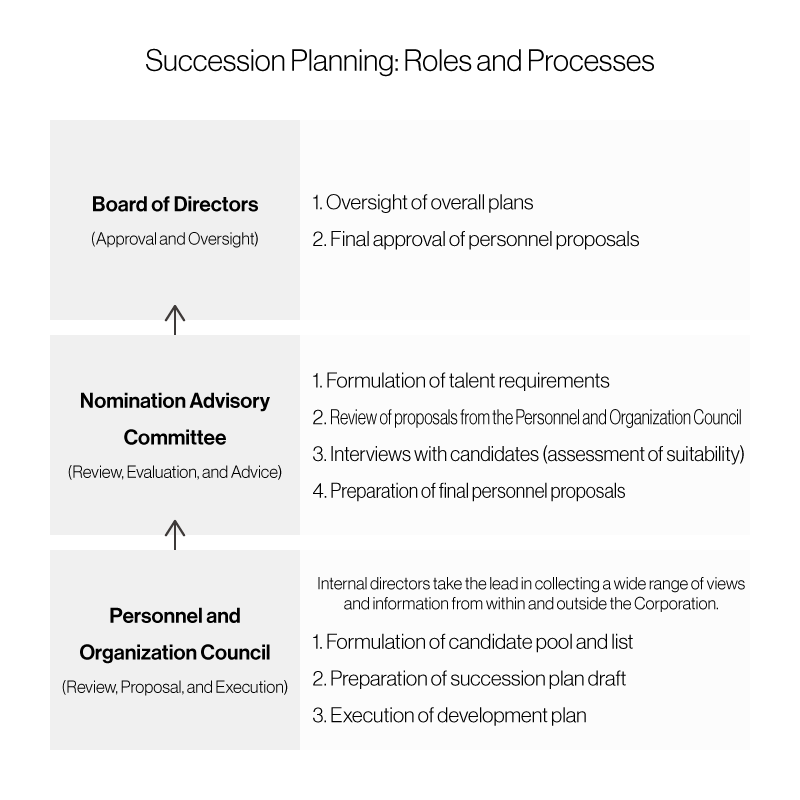
Succession planning for senior executives, including top management, is one of the most important issues required under Japan’s Corporate Governance Code. At Rinnai Corporation, we formulate and implement succession planning under a framework centered on the Personnel and Organization Council and the Nomination Advisory Committee, ensuring transparency and objectivity.
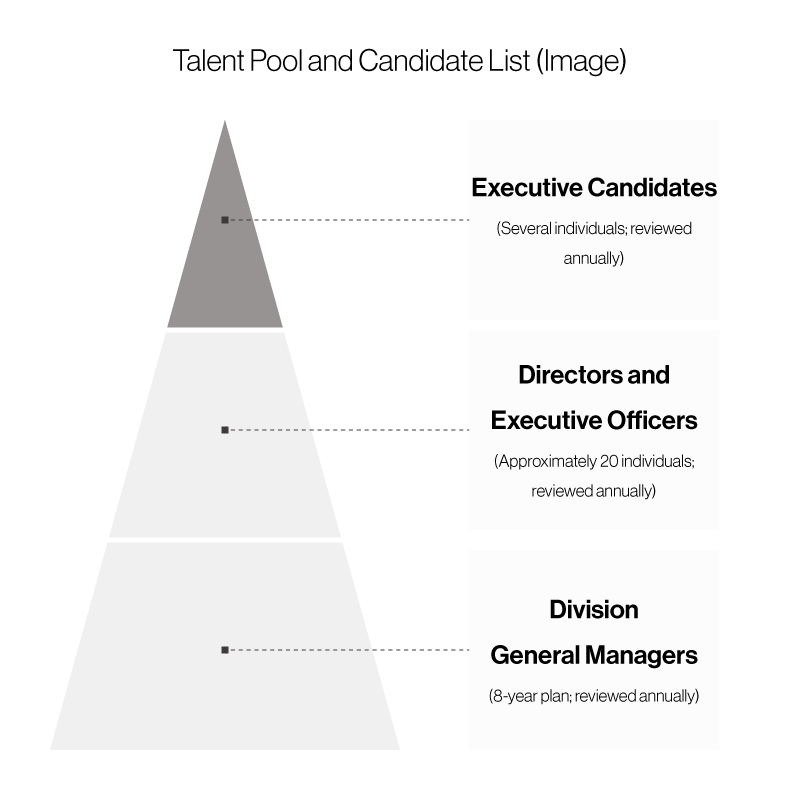
Our Personnel and Organization Council, consisting mainly of internal directors, evaluates candidates for future top management and executive roles from multiple perspectives-including performance, experience, and qualities—based on the talent requirements set by the Nomination Advisory Committee. It then carries out their selection and development in a planned and phased manner. We manage evaluation and development over the medium to long term and carry out periodic reviews as a fundamental premise.
The Nomination Advisory Committee, acting from an independent standpoint, regularly reviews the evaluation and development of candidates conducted by the Personnel and Organization Council and provides advice and recommendations on their validity and appropriateness. It also submits recommendations to the Board of Directors on key appointments, including those of top management and division general managers. In addition, each year it reviews whether incumbent directors should be reappointed or not and submits the matter to the Board of Directors for resolution.
Taking into account the Nomination Advisory Committee’s recommendations, the Board of Directors provides ongoing oversight of succession planning and ultimately determines appointments of senior executives and division general managers, including top management. We have also established a framework to address unforeseen circumstances, thereby ensuring business continuity.
Through these processes, we aim to reduce the risks associated with leadership transitions and strengthen our management framework to support sustainable growth and enhance corporate value.
Remuneration for Directors and Audit & Supervisory Board Members
Total amount of remuneration for fiscal 2026, ended March 31, 2026
| Category | Total Remuneration (Millions of yen) |
Total Remuneration by Item (Millions of yen) |
Recipients (persons) |
||
|---|---|---|---|---|---|
| Basic component | Annual bonus | Restricted stock | |||
| Directors (including outside directors) |
436 (40) |
292 (40) |
118 (-) |
26 (-) |
9 (4) |
| Audit & Supervisory Board members (including outside members) |
52 (16) |
52 (16) |
- (-) |
- (-) |
4 (2) |
| Total (including outside members) |
488 (56) |
344 (56) |
118 (-) |
26 (-) |
13 (6) |
1. Basic principles on determining compensation for directors
(1) Promoting solid corporate value creation over the medium to long term
- The level and composition of compensation are set so that directors will be strongly motivated to realize increased corporate value and attain goals through the concerted efforts of the entire Corporation.
- Directors will be motivated to routinely attain performance targets every fiscal year and create corporate value over the medium to long term by exercising appropriate quantitative evaluation on the basis of financial performance indicators and assessment of medium- to- long-term efforts on compensation.
- Steady improvement of corporate value is sought through directors holding the Corporation’s shares for the medium to long term, thus having common interests with shareholders.
(2) Securing objectivity and transparency to underline our accountability to a broad range of stakeholders, including shareholders
- Policies on determining compensation are deliberated by the Compensation Advisory Committee, mainly composed of outside directors, and then ratified by the Board of Directors based on the Committee's recommendations.
- The level and composition ratio of compensation are continuously validated by an objective comparison with those of comparable companies.
2. Structure of compensation
Compensation for directors consists of a basic component (fixed compensation) and a performance-linked component in a ratio of approximately 60:40 for the purpose of providing a sound motivation for increased corporate value and target achievement. Performance-linked compensation consists of an annual bonus, designed to promote steady attainment of performance targets every fiscal year, and a restricted stock compensation, designed to seek steady improvement of corporate value through sharing interests with shareholders by holding the Corporation’s shares for the medium to long term.
Compensation for outside directors is limited to a basic component (fixed compensation) only, in order to promote proper conduct of their duties to supervise and give advice to management from a position independent of executive management.
The composition of compensation and summary of each component are as follows:
Composition of Compensation
- About 60%
- About
20% - About
20%
- Basic component
- Annual bonus
- Restricted stock
| Type of compensation | Summary |
|---|---|
| Basic compensation | Cash compensation paid monthly in a fixed amount based on position and duties |
| Annual bonus |
Cash compensation designed to promote steady attainment of performance targets every fiscal year and corporate value creation over the medium to long term Consisting of a financial evaluation portion (80%) and a nonfinancial evaluation portion (20%)
|
| Restricted stock |
Stock-based compensation designed to contribute to steady improvement of corporate value through shared interests with shareholders by holding the Corporation’s shares for the medium to long term
|
If any individual director holds a number of shares exceeding a specified number over the medium to long term, the director may not be eligible to receive the restricted stock and receive only an annual bonus as a performance-linked compensation incentive given the purposes of performance-linked compensation and effectiveness as incentive. Directors eligible to receive restricted stocks are identified at a meeting of the Compensation Advisory Committee, and then ratified by the Board of Directors.
3. Level of compensation
The level of compensation for directors (excluding outside directors) is set so that directors are strongly motivated to realize increased corporate value and attain goals through the concerted efforts of the entire Corporation. It is determined on the basis of position and duties and by using objective data on executive compensation gathered through a survey conducted by an outside expert agency (Willis Towers Watson’s Executive Compensation Data) and using those of selected comparable companies as a benchmark.
4. Stock ownership guidelines
Effective the 75th fiscal year (ended March 31, 2025), the Corporation will establish the following guidelines for the number of shares of its stock to be held by directors during their terms of office, with the aim of steadily increasing corporate value and further promoting common interests between directors and shareholders.
- President and representative directors: Shares equivalent to 1.5 times the amount of base compensation by the end of three years after assuming office
- Other directors (excluding outside directors): Shares equivalent to one time the amount of base compensation by the end of three years after assuming office
5. Malus and clawback provisions
The Corporation has introduced a system under which corrective actions may be taken if material revisions are made to the financial statements used as the basis for bonus calculation, or if a serious violation of laws or internal regulations by a bonus recipient is identified. Based on deliberation and recommendation by the Compensation Advisory Committee and a resolution by the Board of Directors, the Corporation may reduce or withhold the annual bonus or request the return of all or part of the amount paid. In addition, under the restricted stock compensation plan, the restricted stock allotment agreement stipulates a clause that allows the Corporation to acquire all of the shares granted without compensation in the event of misconduct by the bonus recipient, such as a violation of laws, regulations, or internal rules.
6. Process of determining compensation
Deliberations of the Compensation Advisory Committee are conducted from an objective viewpoint and by referring to expertise about compensation systems. Accordingly, information is obtained from an outside expert agency (Willis Towers Watson in fiscal 2026) when necessary.
Communication with Outside Executives
To strengthen the supervisory function of the Board of Directors and promote the substantive contribution of outside executives (outside directors and outside Audit & Supervisory Board members) to management, we actively provide opportunities for them deepen their understanding of the business. In December 2024, we held a product experience session for outside executives at Hot.Lab, our showroom for clients. This session provided outside executives with an opportunity to enhance their product knowledge and business understanding by seeing, touching, and experiencing key products from our sales division firsthand, while engaging in dialogue with the responsible executive officers.

In particular, during the cooking demonstration of our top-of-the-line, built-in gas hob (stovetop) DELICIA, the outside directors gave high marks to the light weight of the dedicated cookware and the wide range of functions enabled through app integration. They also experienced firsthand the practicality of the “Easy Clean” technology, which prevents stains from sticking on the stovetop surface, as well as the outstanding finish of clothing dried with the Kanta-kun gas clothes dryer. These experiences reaffirmed their appreciation of the high added value of Rinnai’s products and its technological capabilities.


In addition to such product experience sessions, we regularly organize tours of production facilities and key business sites for our outside executives, along with opportunities to exchange views with on-site personnel. This enables outside executives to gain a profound understanding of the heart of our business activities and gain critical information for making appropriate management decisions. At the same time, they serve as opportunities for communication among outside executives themselves.